Spatialities in Italian American Women's Literature by Eva Pelayo Sañudo
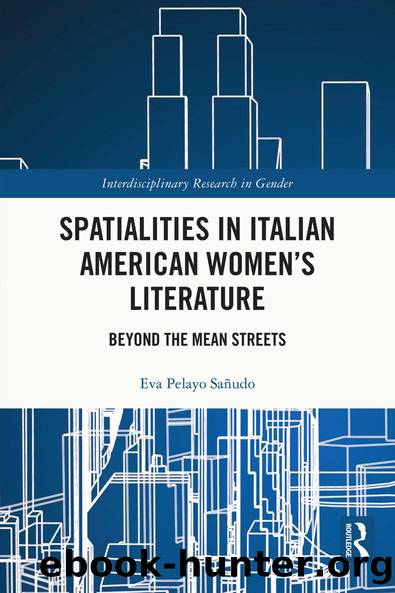
Author:Eva Pelayo Sañudo [Sañudo, Eva Pelayo]
Language: eng
Format: epub
ISBN: 9781000390889
Barnesnoble:
Publisher: Taylor & Francis
Published: 2021-07-05T00:00:00+00:00
In addition, the success of Haleyâs text marked a profound transformation in historical research, since it popularized or helped to admit the value of family history and oral history, displacing the prevailing notions and cultural biases that the written testimony is a more accurate source in all cases, without critical discrimination about the nature of the information being sought (Haley [1998] 2003, 1â2). As an interview by Haley discloses, Roots was fueled by family memories and stories about African life during his childhood; he was especially intrigued by âThe African,â the âfurthest-back personâ (9), whose life story in itself marks the beginning of the African American reverence for family history, in that having been previously sold into slavery had interrupted that possibility of family continuity. By extension, family history proves vital to investigate African American history as this was additionally interrupted by being wiped from official written records (Wall 2005).
Regarding the resurgence of Italian American ethnicity and the ensuing critical debates in the field of literature, this reclaimed identity is nuanced between an alleged renaissance and the reluctance to be acknowledged as minority writing. Literary critic and writer Fred Gardaphe had difficulty in publishing if he did not conform to mainstream expectations about a certain subject matter: the Mafia, and âthe many murders that had occurred in [his] familyâs pastâ (1996, 3). This made him engage in literary criticism as a way âto change the mistaken notions of those editorsâ (3). Facing reactions that accused him of âfabricating this notion of the Italian American writer in order to jump into the new fad of ethnic studies that was hitting the universitiesâ (3), the sociopolitical context was certainly crucial to aid Italian American criticism in recognizing their literary tradition. In fact, this leads Gardaphe to draw on Giambattista Vicoâs model of cultural history as an appropriate frame for the defense of a culture-specific literary model. Criticism was thus linked to the political, and the expansion of the canon was closely related to sociopolitical movements:
it was not the work of critics that refocused attention to the distinctive concerns of women writers any more than black aestheticians initially established the conditions for recognizing the traditions of African-American composition. On the contrary. It was the movements for social, economic, and political changes of the 1960s and 1970s that challenged long-held assumptions about [sic] was significant for people.
(Lauter quoted in Gardaphe 1996, 14)
Download
This site does not store any files on its server. We only index and link to content provided by other sites. Please contact the content providers to delete copyright contents if any and email us, we'll remove relevant links or contents immediately.
| Anthropology | Archaeology |
| Philosophy | Politics & Government |
| Social Sciences | Sociology |
| Women's Studies |
Cecilia; Or, Memoirs of an Heiress — Volume 1 by Fanny Burney(32637)
The Great Music City by Andrea Baker(32610)
Cecilia; Or, Memoirs of an Heiress — Volume 2 by Fanny Burney(32011)
Cecilia; Or, Memoirs of an Heiress — Volume 3 by Fanny Burney(31997)
We're Going to Need More Wine by Gabrielle Union(19110)
All the Missing Girls by Megan Miranda(16324)
Pimp by Iceberg Slim(14668)
For the Love of Europe by Rick Steves(14582)
Bombshells: Glamour Girls of a Lifetime by Sullivan Steve(14138)
Norse Mythology by Gaiman Neil(13459)
Talking to Strangers by Malcolm Gladwell(13441)
Fifty Shades Freed by E L James(13293)
Mindhunter: Inside the FBI's Elite Serial Crime Unit by John E. Douglas & Mark Olshaker(9421)
Crazy Rich Asians by Kevin Kwan(9347)
The Lost Art of Listening by Michael P. Nichols(7549)
Enlightenment Now: The Case for Reason, Science, Humanism, and Progress by Steven Pinker(7355)
The Four Agreements by Don Miguel Ruiz(6836)
Bad Blood by John Carreyrou(6673)
Weapons of Math Destruction by Cathy O'Neil(6370)
